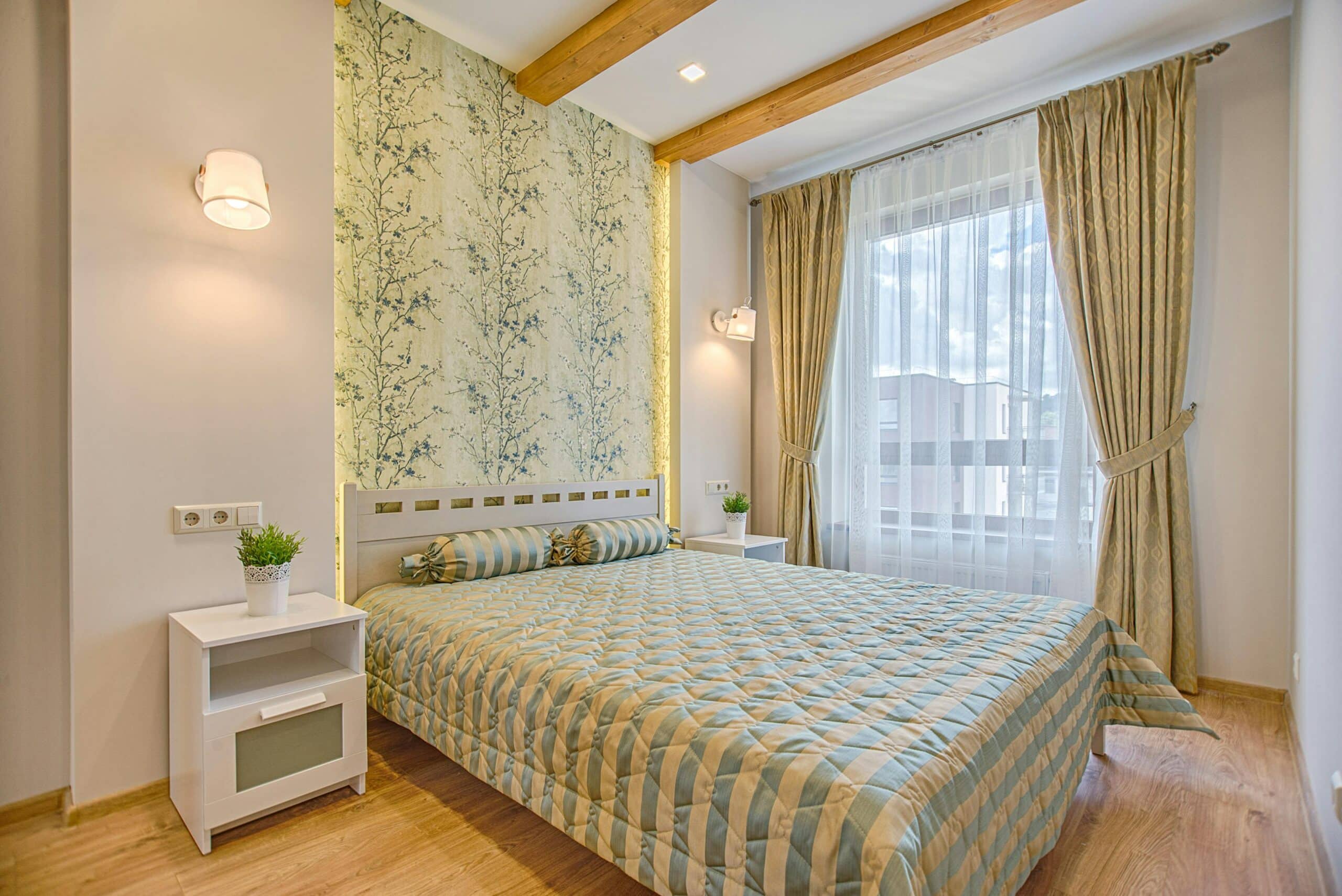

Updated November 2026. By the Tappezzeria Radogna workshop, Isernia, Italy, since 1950.
In short: a blackout fabric blocks almost all light and is the choice for sleeping in the dark. A dim-out fabric darkens the room but lets a little light through, and suits living rooms or people who don’t like total darkness. A lined curtain with a blackout lining makes even a light decorative fabric dark. In every case, light gets in at the edges if the curtain is not wide and long enough.
Blackout, dim-out and lining compared
| Blackout | Dim-out | Curtain with blackout lining | |
|---|---|---|---|
| Light let through | Almost none | A little, the room stays in half-light | Almost none, depending on the lining |
| Look | Denser fabric, often a uniform back | Full fabric, looks like a decorative curtain | Any fabric in front, lining behind |
| Ideal for | Bedrooms, children’s rooms, TV rooms | Living rooms, bedrooms for those who dislike darkness | Rooms with classic or fine curtains |
| Heat and noise | Reduces both a little | Reduces heat a little | Reduces both a little |
How to choose room by room
- Bedroom: blackout or lined curtain. If you wake up with the first morning light, this is the right choice.
- Children’s room: blackout for afternoon naps, ideally in a roller blind inside the window recess, combined with a fabric curtain. No hanging cords within children’s reach.
- Living and TV room: dim-out, or a light curtain in front and a blackout roller behind for film nights.
- Hotel and B&B rooms: a double curtain, sheer plus blackout, in certified flame-retardant fabrics.
Why light still gets in (and how to stop it)
The fabric is only half the job. Strips of light almost always come in from:
- The sides: the pole or track should extend at least 15–20 cm beyond the window on each side.
- The top: light passes between the track and the ceiling. A ceiling-mounted track or a pelmet stops it.
- The bottom: the curtain should reach the floor, or at least well below the sill.
- The centre: with two panels, choose a track with an overlap, where the panels cross over.
For windows where you don’t want a large curtain, blackout roller blinds with side channels are the solution that lets the least light through.
Colour matters
With the same fabric, dark colours stop more light than light ones. If you want a pale curtain, white or linen-coloured, in a room facing east or south, add a blackout or thermal lining behind it: the fabric you like stays in front, and the darkness is behind.
Frequently asked questions
Do blackout curtains keep the house cooler?
Partly: a closed blackout curtain in front of a sunny window reduces the heat entering the room. It works even better with external shading, such as an awning or external Venetian blinds.
Do they reduce noise too?
A little, especially heavy fabrics and lined curtains, which absorb the echo in the room. Against street noise, though, you need good windows.
Can they be washed?
Many blackout fabrics can be machine-washed at low temperature without a strong spin; others need dry cleaning. Always read the label: the wrong wash can damage the blackout coating.
Can I make an existing curtain blackout?
Yes, by adding a blackout lining sewn or hooked behind it. It is a job we often do in our workshop.
See the fabrics in person
In our workshop in Isernia we have been making made-to-measure blackout curtains since 1950. We can send you samples to hold against the light, which is the only way to really understand how much they darken. See our made-to-measure curtains or contact us for a quote, in Italy or abroad.