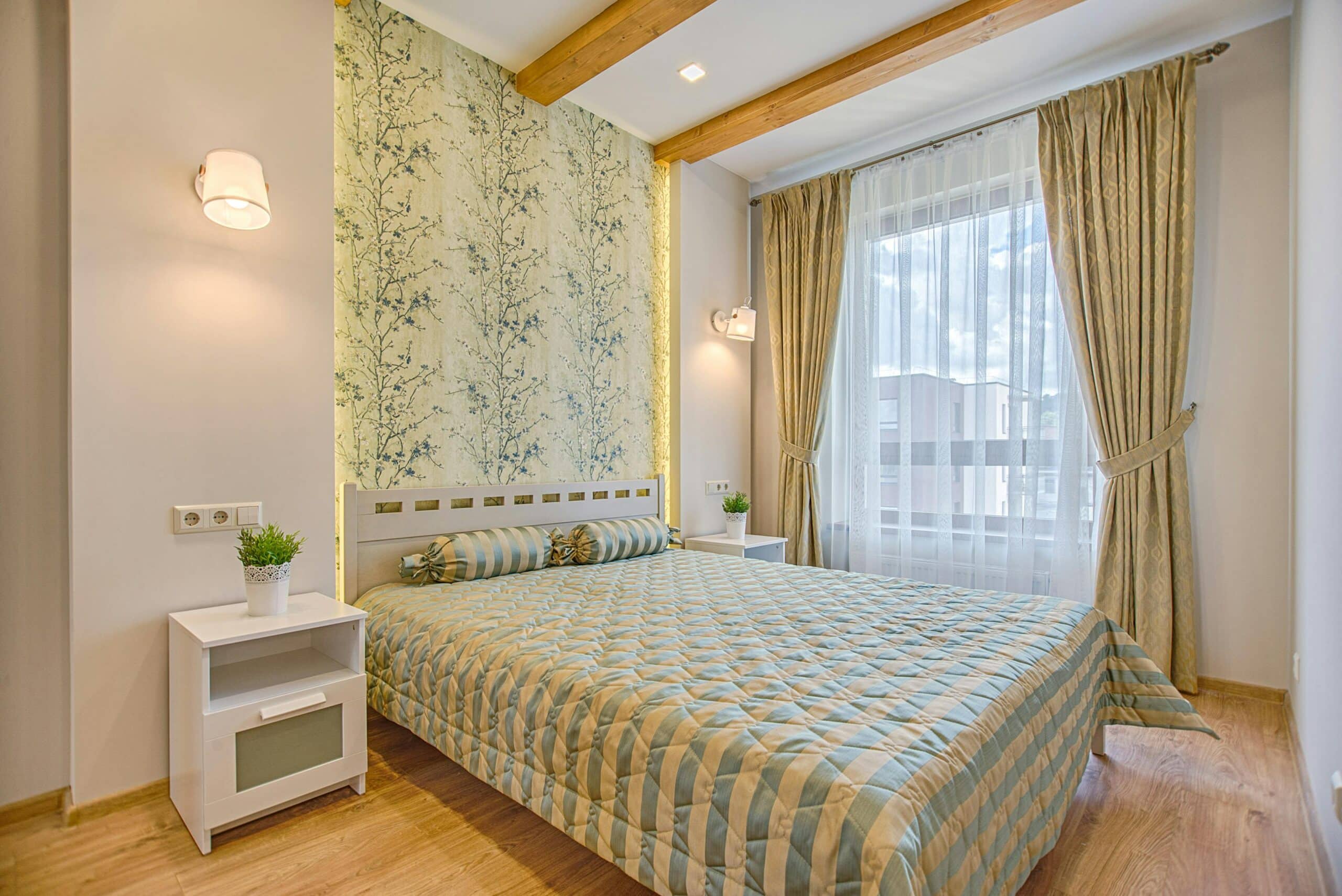

Updated November 2026. By the Tappezzeria Radogna workshop, Isernia, Italy, since 1950.
In short: commissioning made-to-measure curtains from a workshop in Italy, even far from your site, takes seven steps: a clear brief with drawings and photos, verified measurements, samples, a detailed quote, production in the workshop, shipping and installation, and aftercare. The more complete your first brief, the more accurate the quote.
1. The brief: what to send
- Plans and elevations with window sizes, or a room-by-room schedule.
- Photos of each window type, showing ceiling, boxes and radiators.
- Ceiling height and where the track will go: ceiling, wall or a recess.
- Style references: images, mood boards, fabrics already chosen by the designer.
- Quantities and types: curtains, blackouts, roller blinds, upholstery.
- Required fire class for hotels and public spaces. See flame-retardant curtains: standards by country.
- Deadlines: opening date and when the site is free for installation.
2. Measurements
For large projects we survey the site ourselves. Otherwise, the contractor or project manager takes the measurements using our measuring sheet, which explains what to measure and where. Before production we check every unusual measurement together.
3. Samples and prototype
We send fabric samples by courier so you can see them in the light of the site. For hotels we can prepare a sample room: one finished curtain, installed, on which to decide pleat, lining and length before producing the rest.
4. The quote
A serious quote itemises fabric, making-up, tracks and motors, packing, shipping, travel and installation. That way you can compare offers and see what changes if you change a choice.
5. Production
Everything is cut and sewn in our workshop in Isernia, Italy. Each curtain is labelled with its room and window, so nobody on site has to guess where it goes.
6. Shipping and installation
We can ship and install with our own team, in Italy and abroad: on a project in Asia we spent a month on site. Alternatively, we supply ready-to-hang curtains with instructions for your local installer.
7. Aftercare
We keep a record of fabrics, batches and measurements. If a curtain needs replacing in a few years, we can make it again exactly the same.
What affects lead times
| Factor | Effect |
|---|---|
| Fabric in stock or to be ordered | Fabric ordered from the mill takes longer |
| Quantities and making-up | Hand-made pleats, linings and borders need more workshop hours |
| Sample room | Adds a step but avoids mistakes across the whole batch |
| Distance and logistics | Shipping and travel are planned around the site schedule |
Frequently asked questions
Do you work to an architect’s specification?
Yes, it is the most common case in contract work. We follow the design and suggest technical solutions only where needed.
Do you make upholstery too?
Yes: seating, headboards, banquettes and cushions, coordinated with the curtains. See upholstery for chairs and sofas.
Which countries do you work in?
We have worked in Asia and, through Italian contract companies, on projects in the United States, Switzerland and France. See Contract & hospitality.