Updated November 2026. By the Tappezzeria Radogna workshop, Isernia, Italy, since 1950.
In short: a restaurant patio can be covered with folding-arm awnings (the simplest option), pergolas with retractable covers or bioclimatic pergolas (to keep working in the rain). Side enclosures with zip screens or glass make it usable in spring and autumn. Before ordering, check three things: the local patio rules, the permit for public land if the patio is on a pavement or square, and whether the structure needs planning permission.
Which cover for which venue
| Venue | Recommended solution | Why |
|---|---|---|
| Bar with a few tables on the pavement | Folding-arm or canopy awning | Closes at the end of the day, no posts on the ground |
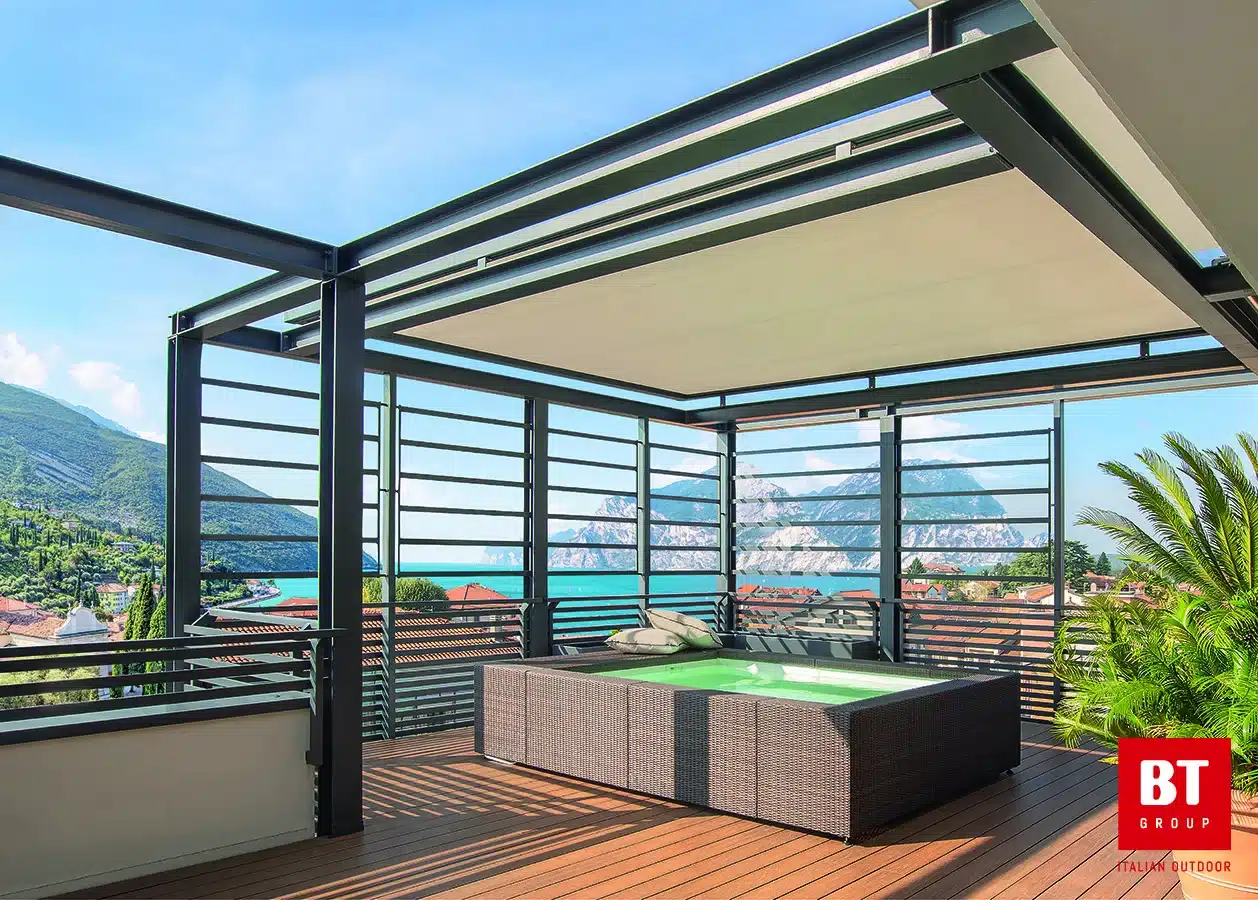
| Restaurant with a private terrace | Pergola with retractable cover | Covers large areas, the fabric folds away |
| Venue open in spring and autumn too | Bioclimatic pergola with zip screens | Keeps out the rain, adjustable louvres |
| Hotels | Modular pergolas with glass enclosures | A stable, bright space that feels like a room |
Covers: what to know
- Awnings and canopies are also a sign: they can be printed with the name and logo of the venue. See canopy awnings and folding-arm awnings.
- Pergolas with fabric covers: the posts resist wind better than a cantilevered awning, and the waterproof fabric keeps off light rain. See pergolas.
- Bioclimatic pergolas: closed louvres act as a roof; with integrated LED and heaters the patio works in the evening too. See bioclimatic pergolas.
Side enclosures
Wind and rain screens in clear PVC or fabric, with a zip system, come down when needed and roll up in summer. Sliding glass enclosures feel more closed and insulate better, but check them with the local authority, as they can turn the patio into an enclosed volume.
Rules to check
- Local patio rules. Many cities set materials, colours, heights and whether side enclosures are allowed, fixed or removable.
- Public land permit. If the patio is on a pavement, square or street, you need a permit that also sets the maximum area, including the projection of the cover.
- Planning permission. A structure that stays up for years and permanently extends the venue may need it, even if it can be dismantled.
- Heritage areas. Historic centres often have extra requirements.
- Fire safety. For covers and curtains in public venues use certified flame-retardant fabrics and keep the certificate for inspections. See flame-retardant fabrics by country.
Our advice: before signing a quote, ask the local planning office which procedure applies to the structure you want. We provide technical data sheets, drawings and fabric certificates for the application.
Mistakes to avoid
- Choosing a cover only for summer when the venue wants to work in autumn too.
- Underestimating wind: a patio in an open square gets gusts from every side.
- Fitting fixed enclosures without checking the rules: the most common source of disputes.
- Fabrics without a fire certificate.
Frequently asked questions
Can a patio be heated?
Yes, with electric infrared heaters, also integrated into the pergola. Gas patio heaters are subject to safety rules and some cities restrict them.
Do you work with venues outside Italy?
Yes. We produce in our workshop in Italy and install with our own team. See Contract & hospitality.